Blog · session planning
Rebuild your rugby weekly session planner from the last two matches
How to run a rugby weekly session planner that rolls with the punches: audit the last two matches, pick one technical, structural and strategic focus, and build next week's session in twenty minutes.
A good rugby weekly session planner is supposed to be the spine of your season — until four matches in, when the squad you have stops looking like the squad you planned for. Injuries. Class commitments. Transfers in and out. The attack pattern you wrote in August around your experienced 10, who’s now on crutches. The plan stops fitting.
This post is a weekly routine for college club coaches in that spot — a way to rebuild next week’s session from what the last two matches actually showed, instead of marching through a plan written before kickoff. About twenty minutes, every week. Same rhythm, no panic. It’s pen-and-paper-friendly, and it’s the spine of how SetPiece is built — if you’d rather have an app hold the bookkeeping while you focus on the coaching, that’s there too.
Why your August plan stopped fitting (and why that’s normal)
Every new season starts the same way. The list of returners. The foundation from last year. The new recruits, fresh in and ready to rock, slotting into a season plan you wrote in August with the squad you thought you’d have.
Then you’re four matches in and the session you planned for this week back in August feels irrelevant. You’re pulling players up from your depth chart who still feel fresh to contact. Your attack plan revolved around a few key bodies — your experienced 10 went down in week 1, and your backline looks nothing like you sketched. This is college club rugby. Squads roll over every September. People get hurt, drop classes, transfer in, transfer out. You roll with the punches.
So why can’t your season plan roll with you?
It can — but only if you stop treating it as a fixed track and start treating it as a starting point. The August plan was a best guess. After four matches, you have something better than a guess: you have evidence. The rest of this post is a weekly routine for turning that evidence into next week’s session, in about twenty minutes, without ripping up everything you wrote in pre-season.
Audit the last two matches in 15 minutes
Use everything at your disposal, but trust that the shortcomings are usually obvious. It’s typically pretty clear right away what part of your plan didn’t hold up. Unfinished tackles. Lost rucks. Broken phases. Weak attack.
Go back and watch the film with those moments in mind. Which ones still stick out the second time through? Which ones were the match, and which ones were one bad rep you happened to remember? The film is the tiebreaker.
Keep the list short — three to five things that broke. Don’t try to explain why yet. Name them in plain language: “backs running out of room on phase three”, “slow ball in the rucks”, “missing post and pillar around defensive rucks”. Short, specific, the kind of line you could say to your captain in the parking lot and they’d nod.
Pick one focus the squad actually needs
Here you have a choice: train for the match ahead, or train for the late-season peak. Sometimes they’re the same session. Often they aren’t. Decide which lens you’re using before you pick anything.
Then sort your list into three layers and pick one from each:
- Skills (foundational). Pass/catch, tackle form, ruck. If one of these showed up in your audit, it becomes your primary technical focus — the skill you drill. Foundations come first because nothing above them holds without them.
- Structure. Slow ball, weak attack pace, broken defensive lines. Pick the biggest offender. This is your secondary focus — the shape you train.
- Strategy. Wide ball, exiting the 22, stressing the back three. Pick one — and nail it.
Direction depends on the lens. If you’re focused on Saturday, start at strategy and work backwards: what does this opponent demand, and what skills underneath have to be live to execute it? If you’re building toward a late-season peak, build from the bottom up: lock skills, then structure, then strategy. Most weeks, the right answer is one technical, one structural, one strategic — and you train all three in one session.
Build this week’s session around that focus
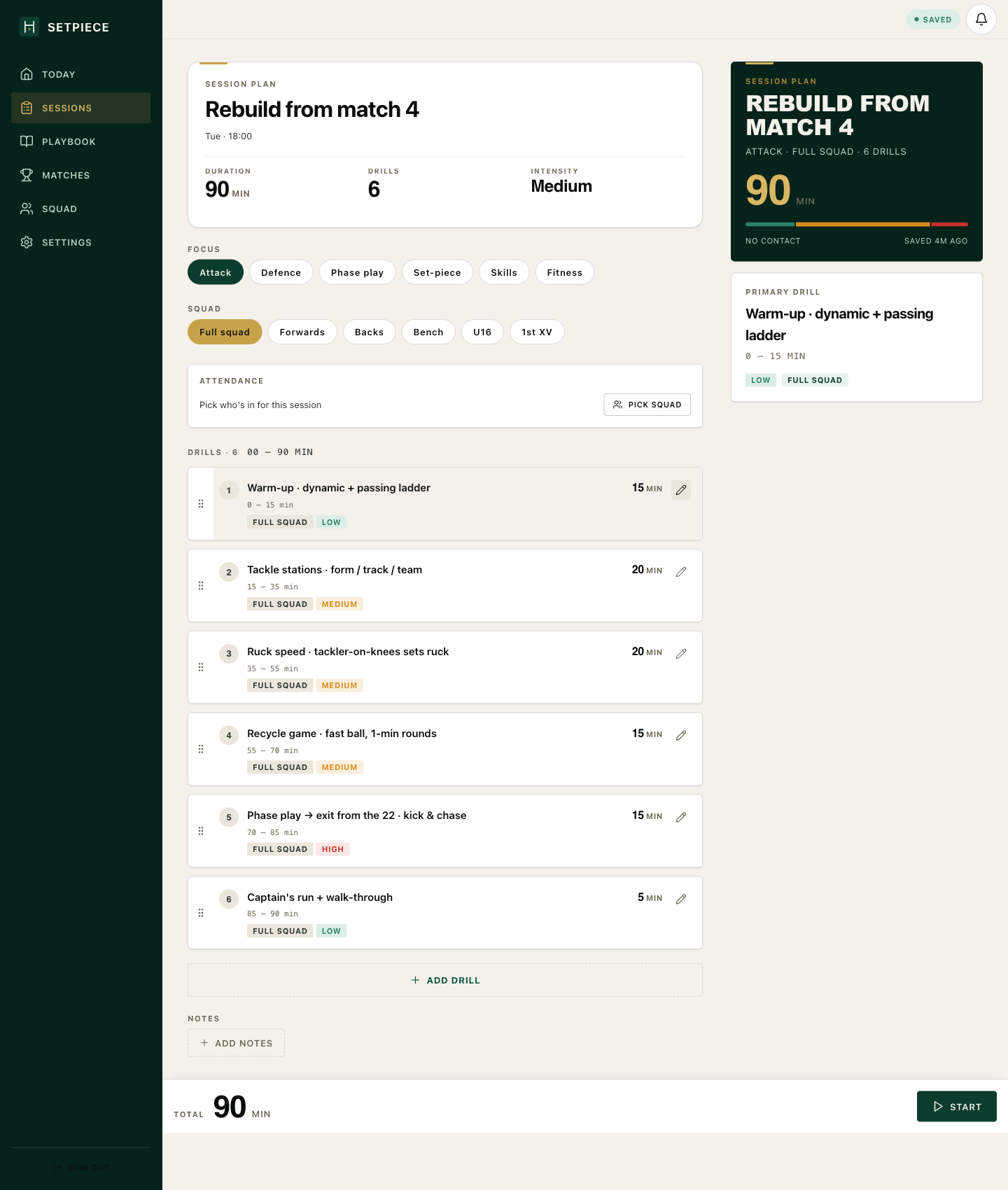
Always hit your technical focus early with a dedicated drill. Tackle form was the pain point? Start with a tackle progression, or drill stations that work separate components — form, tracking, team tackle. Skills first, when legs and minds are fresh.
Then move to your structural piece, and layer the technical work into it wherever you can. Say slow ball at the breakdown is your structural focus. Instead of pad holders setting the ruck, put a tackler on his knees doing the work — and you’ve reinforced tackle form inside a ruck-speed drill. From there, drill into game. “Recycle the ball as many times as you can in a minute” is a small-sided constraint game that lets you keep coaching the same skill under pressure.
Last, fold what you’ve built into the strategy block. Working on exits from the 22? Extend the previous drill: two fast rucks at midfield, then exit kick and chase. The session stops being three things and starts being one connected story — the tackle you cleaned up in minute 5 is the tackle setting the ruck in minute 25 that produces the ball you exit on in minute 45. Simple, repeatable, memorable.
Here’s what that session looks like in the planner — same example, all three focuses stitched in, total reconciled:
Make it rolling — not a rewrite, a habit
Re-audit every match. Same fifteen minutes, same three-to-five list, same three layers. Fix what needs fixing to support the plan, and otherwise stay the course.
The judgement is in the staying. Not every bad moment is a training problem. Before you swap something into next week, ask: was that breakdown actually about a gap in our training, or was it about something else — who was on the field, what the opponent did, weather, fatigue, a single rep that didn’t represent the squad? And the harder question: does this need to be addressed to support the vision you’re building toward? If the answer is no, leave it alone. Reacting to every bad rep is how you end up with thirteen weeks of incoherent sessions and a squad that never feels like it’s getting better at anything in particular.
The August plan was a starting point. The weekly audit is what keeps it alive. Together they’re a rolling plan — and a rolling plan is the only kind that survives a college season.
If you want a planner that holds the audit, the focus, and the session shape on one screen — and runs the session from the touchline on Saturday — join the SetPiece waitlist. One app, one team, one price.